Start your 3-day free trial
Sign up to experience all premium features at no cost.
*Available only to new users. Each user is limited to one trial.
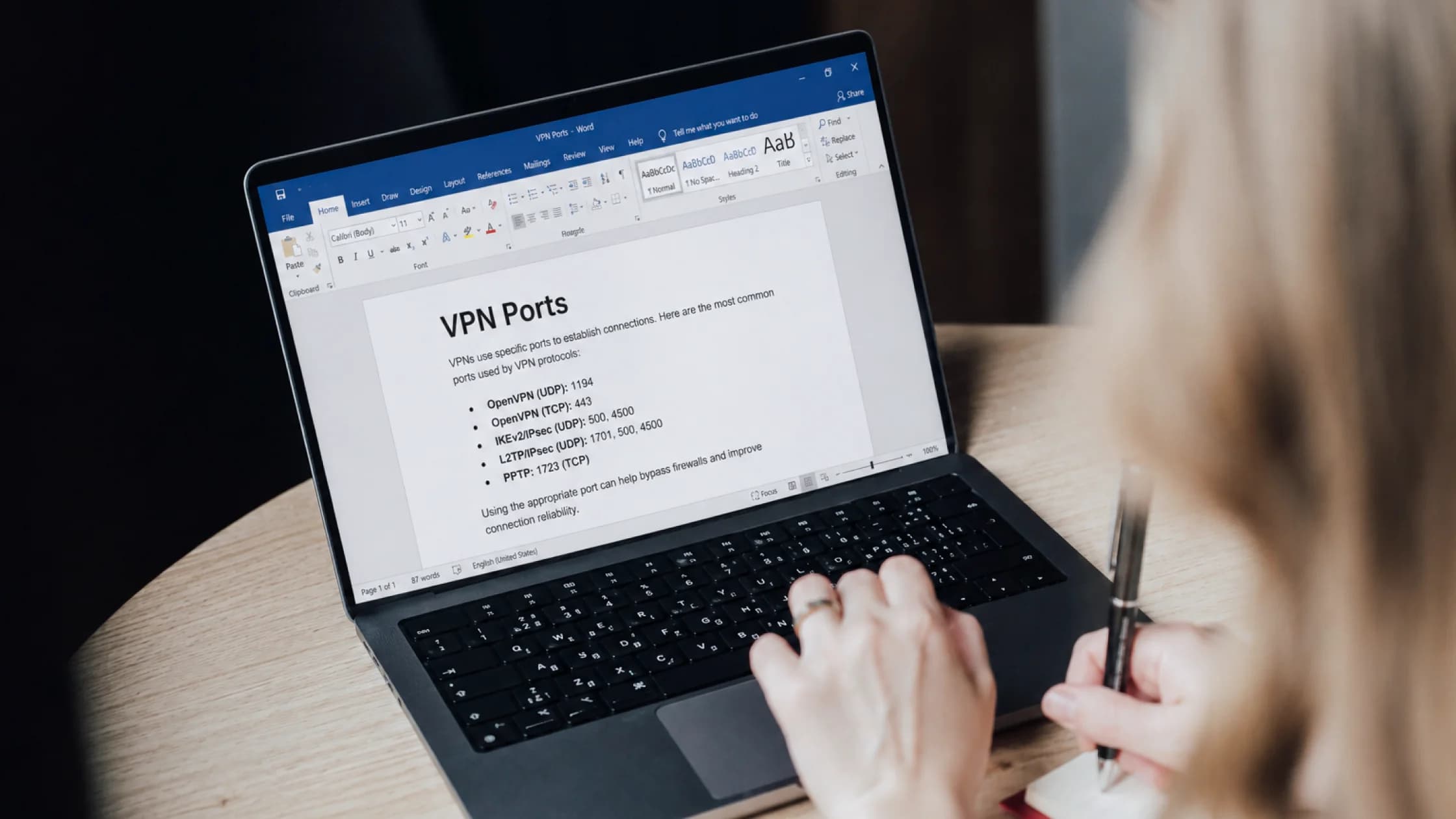

VPN ports are the network "door numbers" VPN traffic uses when it moves between your device and a VPN server. Different VPN protocols commonly use different ports, and that can affect how a connection is made, how compatible it is with a network, and whether it is more likely to be throttled or blocked in some environments.[1][2][3]
If you only want the quick answer: a VPN does not use one single fixed port. OpenVPN often uses 1194, IPsec/IKEv2 commonly uses 500 and 4500, L2TP often uses 1701, PPTP often uses 1723, SSTP often uses 443, and WireGuard commonly defaults to 51820/UDP.[1][2][4][5][6]
If the networking terms in this article feel abstract, the complete VPN guide explains the tunnel, exit IP, and encryption model before you troubleshoot this specific case.
Key Takeaways
- A VPN port is not "faster because it is larger" or "safer because it is obscure"; it is part of the protocol and network stack.
- A VPN protocol usually has one or several typical ports, but many services also support custom ports or obfuscated transport.[1][4]
- If a port is blocked, the whole VPN is not necessarily broken. The current network may be limiting a protocol signature or port.
443is discussed so often because it shares the common HTTPS exit path and is harder for strict networks to block outright.[6]- When choosing a VPN, multi-protocol switching and fallback options matter more than memorizing a port table.
A port is a transport-layer number used to distinguish services. IANA manages service name and port number registration, while operating systems and network devices use protocol, port, and traffic characteristics to decide how a connection should be routed, filtered, or blocked.[1]
So when people ask about a "VPN port," they are really asking: which network entry point does this VPN protocol usually use to communicate with the outside world?
It is not very different from 80, 443, or 22 that you may have seen elsewhere. The service carried over that entry point just happens to be VPN handshake and tunnel traffic.
This table is the part worth saving. If you want to understand the protocols first, then return to ports, read What Is OpenVPN? How It Works, Pros, Cons, and Who Should Use It and VPN Protocols Explained: OpenVPN, WireGuard, IKEv2, and More.
| Protocol | Common ports | Notes |
|---|---|---|
| OpenVPN | 1194 (default, often UDP)[2] | Can also run over TCP; many services support custom ports |
| WireGuard | 51820/UDP (common default)[4] | Lightweight design; usually uses UDP |
| IKEv2/IPsec | 500/UDP, 4500/UDP[3] | 4500 is commonly used for NAT Traversal |
| L2TP/IPsec | 1701/UDP plus IPsec-related ports[5] | Older, but still seen in some setups |
| SSTP | 443/TCP[6] | Uses the common HTTPS port and often passes through strict networks more easily |
| PPTP | 1723/TCP plus GRE[7] | Compatible with old devices, but no longer recommended |
443?Because 443 is the standard port for HTTPS. Websites, apps, and enterprise services depend on it, so network administrators usually cannot block all 443 traffic without breaking a large part of the web.[6]
Many VPN services therefore offer a connection mode that uses 443. It does not mean the connection is completely invisible, but it can have a better chance of passing through strict networks.
One detail is easy to miss: networks often identify more than a port number. They may also look at handshake behavior, protocol fingerprints, and traffic patterns. Moving a protocol to 443 does not guarantee it will avoid detection.
They can, but they are not the deciding factor.
Speed is more often shaped by:
In plain terms, when a port "feels faster," the real reason is usually the protocol behind it and the current route, not the port number itself. For a fuller comparison, read VPN Protocols Explained: OpenVPN, WireGuard, IKEv2, and More.
There are three common reasons.
Companies, schools, hotels, and public networks may block unknown UDP traffic or allow only specific service ports as part of their security policy.
Some networks look beyond the port. They combine protocol handshakes, TLS characteristics, packet length patterns, and connection behavior. That is why "I changed the port but it still will not connect" is not unusual.
Frequent small packets, repeated handshake failures, and port-scan-like attempts may trigger risk controls on the network side.
The easier order is usually:
That is more effective than staring at a port number from the start. Most users are not missing "port knowledge"; they are using a protocol that does not fit the current network. If you are troubleshooting this, read VPN Not Connecting? Common Causes and Fixes.
No.
This is a common mix-up. A VPN connection using a port means the entry point used by the client and VPN server to establish a tunnel. Port forwarding means forwarding an inbound request from the outside to your local device or an internal service. They are different concepts at different layers.
If you often mix them up, read What Is VPN Port Forwarding? How It Works, Uses, and Risks.
If you are not a network engineer, these three points are enough:
443 often helps with pass-through, but it is not a magic keyNo. Different protocols use different ports, and many services support alternative ports or transport modes.
The most common one is 1194, usually over UDP.[2]
WireGuard commonly defaults to 51820/UDP.[4]
Because it usually runs over 443/TCP, the same common port used by HTTPS, so it can pass through some strict networks more easily.[6]
Not necessarily. Changing the protocol, transport mode, or network environment can often restore the connection.
443 impossible to detect?No. 443 can pass through some networks more easily, but many restrictions also inspect handshake behavior, traffic patterns, and protocol fingerprints.
No. The first is the entry point a protocol uses for a connection. The second forwards inbound outside requests to an internal device or service.
Disclaimer: This article is for general networking knowledge and security education only. It does not constitute network deployment, censorship-circumvention, or compliance advice. Specific protocols, ports, and transport modes depend on the software version, device system, and network policy in use.
AethoVPN can be considered for the VPN task in “VPN ports: common ports, protocols, and blocking”, with current device availability and local conditions checked through official channels first.
Sources:
Sources checked 8 May 2026.
Related Articles:
Sign up to experience all premium features at no cost.
*Available only to new users. Each user is limited to one trial.