Start your 3-day free trial
Sign up to experience all premium features at no cost.
*Available only to new users. Each user is limited to one trial.
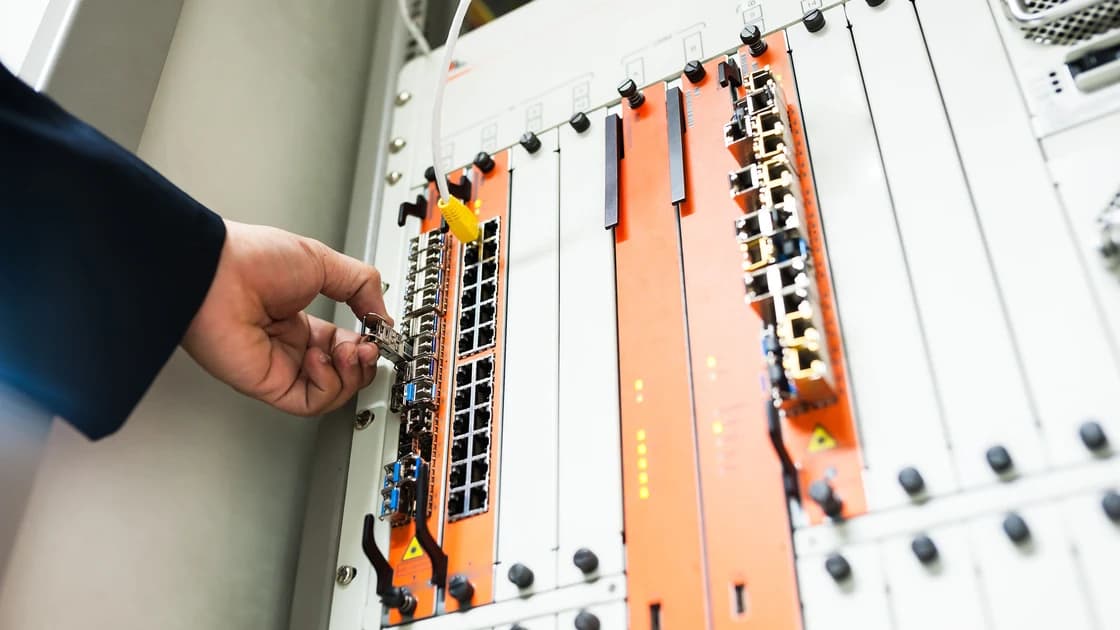

Deep packet inspection is traffic examination that looks beyond basic network addressing to identify protocols, inspect available content, or apply policy. Encryption changes what an inspection system can read, but it does not remove every observable feature of a connection.[1]
Key Takeaways
- DPI is a family of inspection techniques, not a universal ability to read encrypted messages.
- Protocol classification, content inspection, and traffic-policy enforcement are separate jobs.
- A passive observer sees different information from a managed TLS inspection proxy.
- An encrypted VPN can remain recognizable without exposing its inner payload.
- Classification can be wrong; a block message is not proof that private content was decrypted.
An ordinary packet filter can use source and destination addresses, ports, and transport protocol. DPI adds examination of information carried beyond that basic header decision, where the information is available. A system might identify an application protocol, look for a permitted content pattern, or associate a connection with a policy category. Which job it performs depends on the product and deployment.[1][2]
Consider a parcel. Reading the delivery address resembles a basic filter; examining an available contents description resembles deeper inspection. An encrypted parcel does not become transparent just because someone has a more sophisticated sorting machine. The analogy also has a limit: network devices can combine several packets and observations, rather than making every decision from one packet in isolation.
“DPI” therefore does not name a single decoding step or an identical feature set across firewalls. A network owner may combine inspection with access rules, logging, and application control. Those decisions can share an interface while relying on different kinds of evidence. Ask what information was actually examined before assuming the device could read a particular message.
The basic VPN traffic model distinguishes your device, network path, VPN endpoint, and destination service. Place the inspection system somewhere on that path before describing its visibility. A statement about a destination server's access to its own messages does not describe an ISP's access to encrypted traffic passing through its network.
Filtering decides whether traffic may pass. Classification assigns an interpretation, such as an application or protocol category. Content inspection examines readable payload information. A device can filter using a classification result even when it cannot read the protected content that interests you.
| Function | Input it may use | Result | Limit |
|---|---|---|---|
| Basic packet filtering | Addresses, ports, transport protocol | Allow or deny a flow | A port is not definitive application identity |
| Protocol classification | Available message structure and connection behavior | A likely protocol category | Some evidence is incomplete or ambiguous |
| Readable-content inspection | Unencrypted or legitimately decrypted payload | A match against content policy | Ciphertext alone does not supply plaintext |
| TLS inspection | Traffic terminated by a trusted inspection proxy | Inspection of that proxy's plaintext leg | Requires an appropriate trust and deployment arrangement |
| Policy enforcement | Rules and one or more observations | Block, permit, log, or apply another action | The action does not prove the classification was correct |
A port number is useful context, but many applications can use the same transport port. A label derived from several characteristics can be more informative, yet it still needs an error boundary. If the system reports an application category, treat that as its classification result rather than a direct transcript of the user's activity.
Content scanning can help a network owner enforce an authorized policy or detect known threats in traffic it can legitimately examine. It can also expose sensitive material if the inspection deployment is poorly governed. The relevant questions include who operates the system, which connections it handles, what it records, and how exceptions are managed. The acronym by itself answers none of those governance questions.[2]
Encryption protects content within its defined boundary. TLS protects application data between the TLS endpoints, while observable network properties remain outside that protection. A passive intermediary generally sees where packets travel, their timing, and their sizes; the exact additional handshake information depends on the protocol and configuration. Do not assume either total visibility or total invisibility.[3]
The figure distinguishes three observation conditions. It does not claim that a device can move from the encrypted-transit condition to the readable-content condition merely by enabling a setting. The trust relationship and the point at which encryption terminates are part of that change.
| Observer and condition | What may be observable | What is not established by that observation |
|---|---|---|
| Passive transit observer, plaintext protocol | Network metadata and available payload | That every connection on the device uses plaintext |
| Passive transit observer, protected TLS session | Addresses, timing, sizes, and available handshake information | The protected message text |
| Passive observer before a VPN endpoint | Tunnel endpoint and outer connection characteristics | The inner application's protected content |
| Authorized TLS inspection proxy trusted by the endpoint | Plaintext at the proxy's termination point | The same access for an unrelated passive observer |
| Destination service terminating TLS | Its own received application data | Access to all other services or device applications |
A classifier can recognize a probable type of encrypted connection without recovering its keys or message text. That is similar to recognizing a vehicle category without seeing what is inside its cargo compartment. The technical conclusion is narrower than “the network read my private conversation.” Keep that narrower conclusion when interpreting a blocked connection or an application label.
A VPN protects the path between the device and VPN endpoint, subject to its routing configuration. HTTPS may separately protect a web session between browser and website. Removing or terminating one encryption layer does not automatically remove the other. This distinction prevents both exaggerated VPN privacy claims and exaggerated inspection claims.
A managed TLS inspection deployment can terminate one TLS connection and establish another. The client must trust the inspection certificate arrangement for that operation to work as intended. The proxy then handles plaintext at its own termination point, which is a different architecture from passively watching end-to-end ciphertext. Fortinet distinguishes deep inspection from certificate inspection in its documentation.[4]
A managed workplace device may be configured for such inspection under its administrator's policy. A personal device with an unexpected certificate warning is a different situation. Do not install an unfamiliar trust certificate just to bypass a warning on public Wi-Fi. Confirm the operator, purpose, and required authorization before accepting a change to device trust.
Not all applications or connections behave identically under inspection. Certificate pinning, mutual authentication, application requirements, and policy exclusions can affect whether a connection is inspected, excluded, or fails. The absence of an inspection result is not proof that the connection contains nothing sensitive. Likewise, a failure is not a reason to disable security checks without the responsible administrator's involvement.
This article explains the boundary rather than giving a TLS interception setup procedure. Readers responsible for a network should use the vendor's current deployment documentation and their organization's authorization process. Readers using that network should distinguish the operator's stated policy from assumptions based on the name of the appliance.
A network may classify or restrict a VPN using observable protocol and connection characteristics. It does not need the inner application's plaintext to apply an access rule. The IKEv2 control and data stages show why a tunnel has an externally observable exchange even though selected application traffic is protected.
For readers comparing privacy tools, AethoVPN's tunnel role should be assessed by the protected path and routing scope, not by an assumption that encrypted traffic is undetectable. The differences between VPN protocols help separate a protocol choice from a promise that a network cannot recognize the connection. A tunnel also does not erase what the destination learns from a login or cookie.
More specialized observations belong to separate explanations of TLS fingerprinting and encrypted traffic patterns. Here, the useful conclusion is about visibility: a classification can reveal a category without revealing content. This is not an instruction to manipulate fingerprints or evade a network's controls.
An inspection result is produced from available evidence and a configured policy. Shared infrastructure, incomplete observations, and changing application behavior can make the category uncertain. A policy may also deliberately block a broad category even when the underlying content is harmless. The resulting user-visible failure can look the same as a more specific content block.
If a connection stops working, record the time, the affected application, and the network involved before contacting the network owner. Avoid circulating private message content or credentials as diagnostic evidence. The ways ISPs restrict websites describe several possible layers; DPI is only one candidate explanation. A block alone does not identify which layer caused it.
The practical decision is to match the claim to the evidence. A rule log can establish which policy the appliance applied. It may not establish that the classifier was correct, and it does not establish plaintext recovery unless the deployment actually supplies plaintext. This approach leaves room for useful inspection while keeping its privacy implications precise.
A passive DPI system cannot simply read properly protected HTTPS application data. A trusted TLS inspection proxy can examine plaintext where it terminates the connection, which is a different deployment.
DPI is an inspection capability that a firewall may use. A firewall can also enforce rules from addresses and ports without deeper payload inspection.
VPN detection can be a classification based on observable connection characteristics. That result does not by itself establish recovery of the inner application's protected content.
Visibility depends on the traffic that reaches the inspection point and on encryption boundaries. A network appliance does not automatically see local files, offline actions, or unrelated paths.
An unexpected certificate request changes your trust boundary. Verify its operator and purpose with the responsible administrator before accepting it, especially on a personal device.
A policy can block a broad category, or classification can be uncertain. The block message alone cannot establish malicious content or a precise inspection method.
A VPN changes the network path and visible exit address for routed traffic. Accounts, cookies, and other application identifiers can still link activity at the destination.
Sources:
Sources checked 5 October 2026.
Related Articles:
Sign up to experience all premium features at no cost.
*Available only to new users. Each user is limited to one trial.