Start your 3-day free trial
Sign up to experience all premium features at no cost.
*Available only to new users. Each user is limited to one trial.

Router connected but no internet means your devices reach the local network while the path beyond the router has failed somewhere. To troubleshoot it, find the scope first (one site, one device, one connection type, or every device), compare Wi-Fi with Ethernet, open the router’s local page, then check the WAN, modem, and ISP status before restarting anything. A Wi-Fi connection proves only that the client joined the local network; it does not prove that the router, modem, line, or ISP can reach the internet.
Key Takeaways
- Test a second destination and a second device before changing settings.
- Compare Wi-Fi with Ethernet to separate the radio path from the upstream path.
- A reachable default gateway points toward a modem, line, or ISP problem.
- Restart in a controlled order and wait for status lights to settle.
- Keep factory reset as the final recovery step because it erases the evidence and configuration you may need.
Use the device and app troubleshooting guide if the failure is clearly limited to one client or app. The steps below stay at the router and upstream boundary rather than becoming a device-specific repair guide.
Build a small fault matrix before touching the router:
| Test | Result | Likely boundary |
|---|---|---|
| One website fails; others work | Limited destination or app path | Site, app, account, or filtering issue |
| One device fails; others work | Client-specific | Device Wi-Fi, software, or saved network state |
| Wi-Fi fails; Ethernet works | Local wireless path | Radio, signal, security, or access-point issue |
| Wi-Fi and Ethernet fail on all devices | Router or upstream | WAN, modem/ONT, line, ISP, or router state |
| Local router page works; internet does not | LAN is alive | Router WAN or upstream issue |
Microsoft’s Windows guidance uses the same distinction: if a client can reach its default gateway, it has a path to the Wi-Fi router, so the modem or ISP becomes a stronger suspect.[1] Do not assume the router is broken merely because its Wi-Fi name appears.
Try a second known-good device on the same network. On the failing device, try two unrelated websites or services so a single outage does not look like a network failure.
If other devices work, stop changing the router. Forget and rejoin the network, confirm the device obtained a local address, and use the relevant iPhone or Android guide. Device-wide security software or an app-specific outage may also explain the result.
If every device fails, continue with the shared path. Record the time and current status lights before restarting anything; that evidence can help the ISP identify a line or provisioning problem.
Connect one trusted computer directly to a LAN port on the router. If Ethernet reaches the internet while Wi-Fi does not, the modem, WAN, and ISP path are probably functioning. Focus on wireless enablement, security mode, distance, interference, or access-point state.
Move close to the router and test again. Do not use a speed test as the only signal; first check whether ordinary pages and services connect reliably. If a mesh satellite is involved, connect near the primary node and review the Mesh Wi-Fi boundary.
If neither Ethernet nor Wi-Fi works, the problem is shared. Check the router’s WAN status and move upstream.
Open the router’s documented local administration address, or inspect the client’s assigned default gateway. If the local page loads, the client-to-router path works even when the internet does not.
On Windows, Microsoft documents checking the default gateway with ipconfig and testing it with ping. A gateway reply indicates a connection to the router and shifts attention toward the modem or ISP; no reply keeps the fault on the client, Wi-Fi, cable, port, or router LAN side.[1] Treat this as one diagnostic signal, not a universal guarantee, because some devices block diagnostic traffic.
Do not start changing DNS servers or opening ports. Those changes do not repair a missing WAN link and can hide the original state.
Inspect the physical path without unplugging random cables:
Google’s network guidance separates device distance and interference, Ethernet equipment, router state, and ISP performance. It also notes that restarting the router can clear some connectivity issues without erasing settings.[2] Its product-specific screens are examples, not universal menu paths.
Save work, then use the order documented by the ISP and router manufacturer. A common sequence is to power down the router, restart the modem or optical terminal if the provider allows it, wait until upstream service reaches its normal state, then start the router and wait for its WAN and Wi-Fi states to settle.
Do not repeatedly toggle power every few seconds. Cable, fiber, and cellular gateways can take several minutes to register. Record whether the upstream device returns to an alarm state and whether the router receives a WAN address.
After the restart, retest the same matrix: one wired client, one Wi-Fi client, two destinations, and the local router page. Changing the test each time makes results hard to compare.
If the router or its app reports no internet connection right after you installed or swapped it, the router is probably working locally but not yet accepted by the provider’s network. Check these points in order:
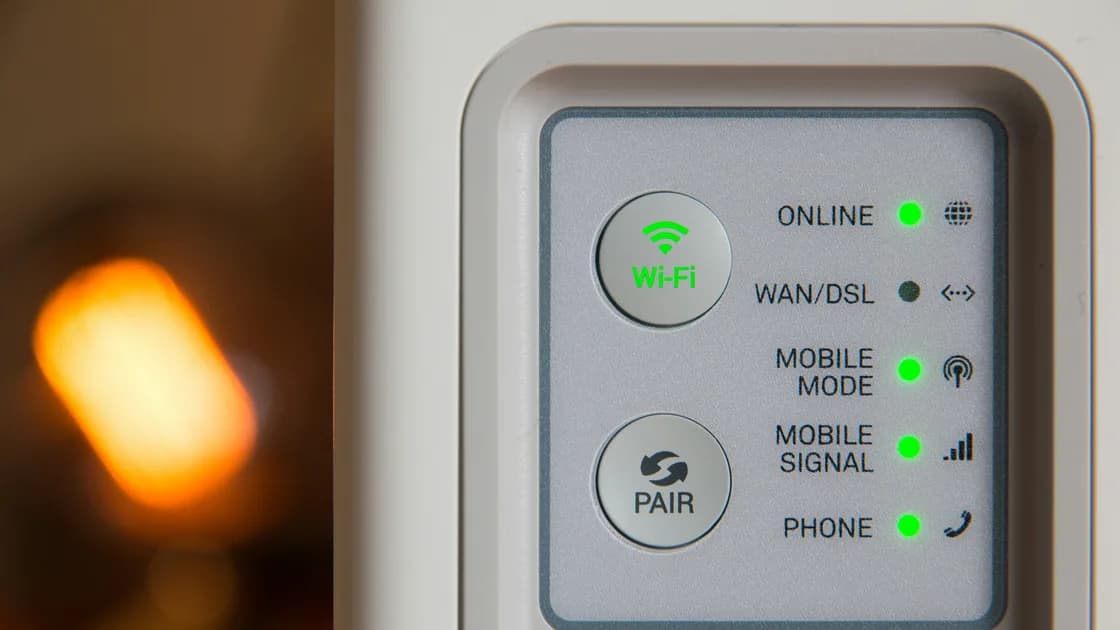
Status lights alone do not settle the question. Power and Wi-Fi lights only show that the router is running; the WAN or Internet indicator and the router’s WAN page show whether it has an upstream connection, and colors mean different things on each model, so check its manual. If the router reports a WAN address but websites still fail, return to the scope and gateway tests above.
Contact the ISP when all devices fail, the router can reach its local clients, the modem or optical terminal shows a service alarm, the router has no expected WAN lease, or the ISP reports an outage. Provide the equipment states, timestamps, and what changed.
Contact the router vendor when the upstream service is healthy but the router repeatedly loses its WAN state, reboots, rejects a known-good cable, or fails after an official update. If a computer can reach the internet when connected in the provider-approved direct test but cannot through the router, that comparison is useful evidence.
Factory reset is the last step, not the first. It removes WAN credentials, Wi-Fi names, guest policies, account settings, and logs that may explain the failure. Before resetting, confirm you have the exact setup instructions, ISP requirements, administrator recovery path, and any supported configuration backup.
Reset only when the vendor or ISP procedure calls for it, the current configuration is known to be corrupted, or all non-destructive checks are exhausted. Afterward, use the new router setup checklist and add one change at a time.
Because the device has joined the local wireless network. The router may still lack a working WAN connection to the modem, line, or ISP.
Try two unrelated destinations and a second device. This quickly separates a site or device problem from a network-wide problem.
A normal restart should not erase saved settings. A factory reset does. Use the documented restart control and avoid pressing a reset button by mistake.
The upstream internet path is likely working. Focus on wireless security, signal, access-point state, saved network credentials, and the device’s radio path.
The local path is working. Check the router’s WAN state, upstream equipment, service line, and ISP status.
Lit power and Wi-Fi lights only show that the router is running and broadcasting. Check the WAN or Internet indicator and the router’s WAN page; an alarm there or a missing WAN address points to the modem, line, or ISP.
No. First prove that the router has an upstream connection. DNS changes cannot restore a missing link or ISP lease.
Wait for the documented normal status, which may take several minutes. Repeated rapid restarts can prevent registration from completing.
Only after preserving the configuration and exhausting non-destructive checks. A reset destroys useful evidence and may require ISP credentials to recover.
Disclaimer: This article provides general troubleshooting guidance. Follow ISP and manufacturer instructions for power, fiber, cable, activation, and factory-reset procedures. AethoVPN cannot create an upstream WAN connection when a router has no internet; confirm modem sync, provider activation, and WAN addressing before VPN.
Sources:
Sources checked 4 October 2026.
Related articles:
Sign up to experience all premium features at no cost.
*Available only to new users. Each user is limited to one trial.